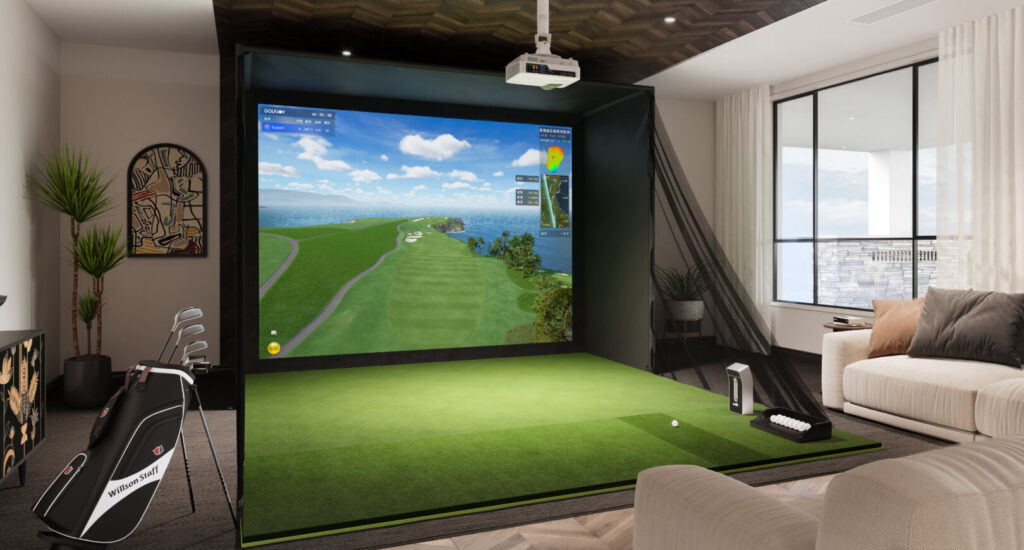

An indoor golf simulator is a system that lets you play and practise golf in an indoor space. The simulator combines sensors, software, and a projection screen to measure your swing and display a realistic ball flight. You play on virtual courses based on real golf courses, complete with wind, slopes, and course obstacles.
The result: a full golf experience without leaving the building. Practise your swing, play 18 holes with friends, or analyse your shot data to sharpen your game.
How Does a Golf Simulator Work?
A golf simulator measures your swing and ball flight using sensors and cameras. The process works in three steps:
1. Measuring your swing and the ball
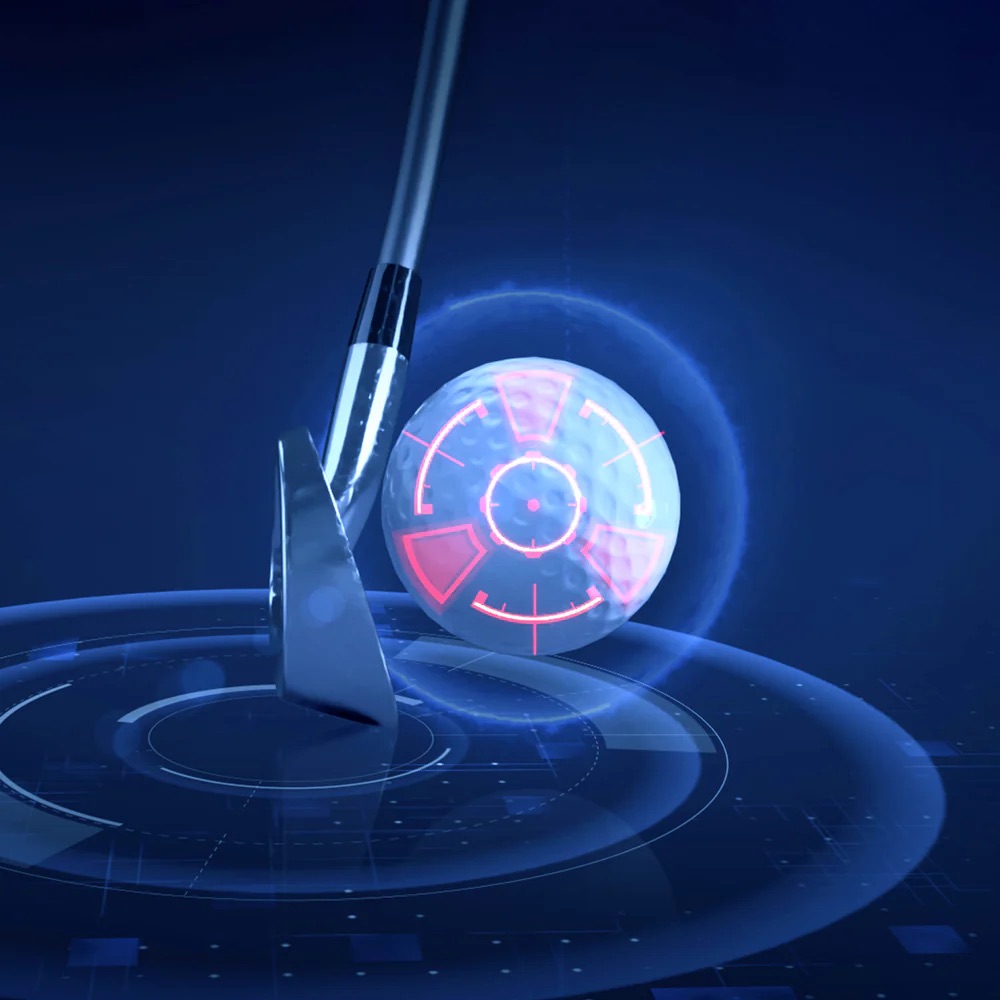
The moment you hit, sensors (called a launch monitor) capture data about the ball and your club. This includes ball speed, launch angle, backspin, sidespin, and club path direction. The GolfJoy Spica 3, for example, records 27 data points per shot using three cameras.
2. Calculating the ball flight
The software converts all that measurement data into a realistic ball flight. Factors like wind, temperature, and course characteristics are taken into account. The more accurate the sensors, the more reliable the result on screen.
3. Displaying it on screen
A projector shows the ball flight on an impact screen. You see the ball fly, land, and roll on a 3D rendering of the golf course. The software also displays wind direction, green slope, and flag position, just like on a real course.
What Components Does a Golf Simulator Have?
A complete golf simulator consists of several components working together. Here’s an overview of the key parts.
Launch monitor (sensors)
The launch monitor is the core of every simulator. This device measures ball and club data on every shot. There are two types:
- Portable launch monitors: compact devices placed next to or behind the ball. Suitable for home use and the driving range. The GolfJoy GDS Pro (1.5 kg) is an entry-level model with dual camera. The Spica 3 features triple camera, a touchscreen, and Wi-Fi.
- Overhead launch monitors: mounted above the hitting zone. They offer a larger hitting area and are ideal for permanent setups. The GolfJoy Rigel 2 provides a 40×40 cm hitting zone, while the Rigel 3 extends to 50×70 cm.
Software
The software determines the visual experience and analysis capabilities. Quality simulator software offers realistic courses in high resolution, practice modes, game modes, and multiplayer options.
GolfJoy 4K comes in three subscription tiers: Basic (30 courses, 2K resolution), ProTour (80+ courses, multiplayer), and Major (160+ courses, 4K resolution). You choose the subscription that matches how intensively you plan to use the simulator.
Projector and impact screen
The projector displays the image on a special impact screen built to withstand golf ball impacts. The projector’s brightness determines how well the image holds up, even in well-lit rooms. The GolfJoy S80 simulator includes a 5,000 ANSI lumen projector. The S90 takes it a step further with 6,000 ANSI lumen.
Computer
The computer processes the sensor data and runs the simulation software. The heavier the software demands (think 4K resolution and realistic physics), the more powerful the computer needs to be. The GolfJoy S90 features an i7 processor with an RTX 4070 graphics card.
Optional components
Depending on your needs, you can expand the setup with extras:
- Smart Putting Platform: a putting surface that simulates slopes and speeds, completing the full golf experience including putting.
- Auto Tee-Up Machine: automatically places a new ball on the tee, convenient during intensive practice sessions.
- 4K All-in-One Smart Kiosk: an additional screen for course selection and data analysis.
- Electronic Caddie Buttons: control the simulator without reaching for your phone or keyboard.
What Can You Use a Golf Simulator For?
A golf simulator is more than just a training tool. There are several applications:
Home practice and play
Practise your swing year-round, regardless of the weather. Analyse your shot data to work specifically on your technique. Or play a round on a world-famous course from your own space.
Commercial venues
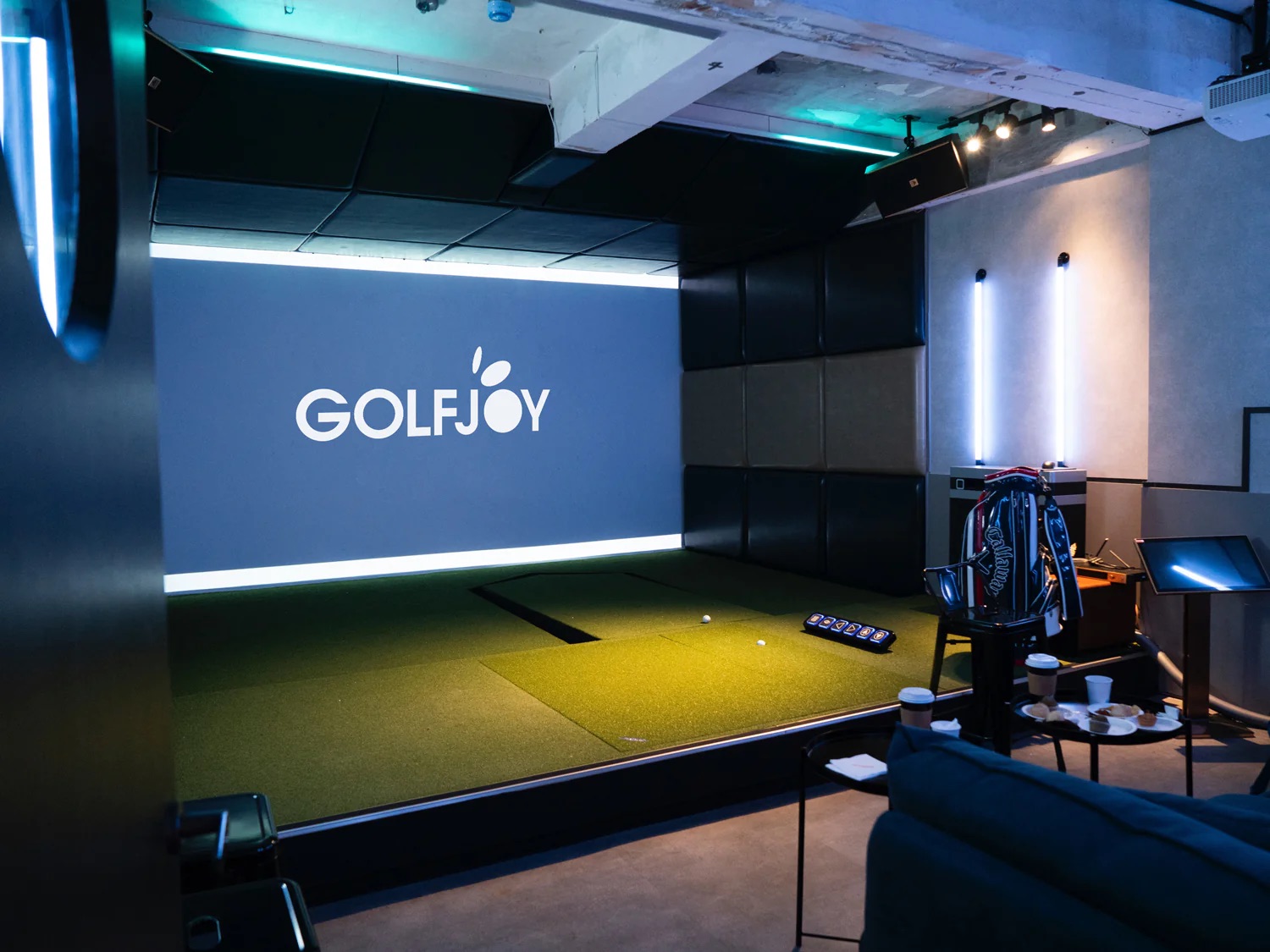
Driving ranges, golf clubs, and sports centres use simulators as an addition to their offering. During winter months especially, a simulator generates additional revenue. Guests book a bay and pay per hour or per session.
Hospitality and entertainment
Hotels, resorts, and entertainment centres offer golf simulators as an activity for guests. The combination of sport and entertainment appeals to a broad audience, including people who don’t (yet) play golf.
What to Look for When Choosing a Golf Simulator
Not every golf simulator is the same. These are the key considerations:
Sensor accuracy
The more data points the launch monitor measures, the more reliable the simulation. A triple-camera system (like the Rigel 3 with 32 data points) offers more detail than a basic model.
Software quality and course selection
Check how many courses are available, at what resolution, and which game modes are included. Multiplayer and practice modes make a difference with frequent use.
Space and installation
Measure your available space carefully. A compact system like the Personal Simulator P7 fits in a smaller room. An S90 setup requires more square metres but also delivers a more complete experience.
Budget and expandability
Set your budget and consider which components you need now versus what you can add later. An ecosystem where you can expand step by step (from launch monitor to full simulator) gives you flexibility.
After-sales support
Choose a brand with local European support. When you have questions or technical issues, you want fast help without time zone differences or language barriers.
Frequently Asked Questions About Golf Simulators
Modern simulators with high-quality launch monitors measure up to 32 data points per shot. Accuracy depends on sensor quality. Overhead systems generally offer a larger and more consistent measurement zone than portable models.
This varies by model. For a compact home simulator, you need a minimum space of approximately 4 metres deep, 3 metres wide, and 2.7 metres high. Commercial setups require more room. Always check the specifications of the specific model.
Yes. Beyond golf, many simulator systems offer additional game modes and games. GolfJoy 4K software includes up to 7 different games and multiplayer options. This makes the simulator appealing even for guests who don’t play golf regularly.
The price depends on the configuration. A portable launch monitor starts at around €2,000. A complete simulator with overhead launch monitor, projector, computer, and software starts at around €20,000. Optional components like a putting platform or auto tee-up come on top of that.
Maintenance is minimal. The impact screen and golf mat wear with intensive use and need periodic replacement. The software is kept up to date through updates. Electronic components are generally maintenance-free.
Next Step
Want to find out which golf simulator fits your situation? Check out the full range of GolfJoy simulators or leave your details so we can determine the right configuration together.